
In the Sensex pack, IndusInd Bank was the top gainer, soaring around 8 per cent, followed by Bajaj Finance, Axis Bank, PowerGrid, ONGC, ICICI Bank, Sun Pharma and M&M.

'The selling in India may emerge as soon as the RBI reverses its interest rate stance.'
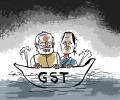
Agra has long been known for the Taj Mahal, but it is also a manufacturing hub filled with micro, small and medium enterprises (MSMEs) that make everything from electronic components to metal products, from paints and chemicals to footwear. And five years after the introduction of the Goods and Services Tax (GST), the MSMEs here complain that while the indirect tax regime has been transformative, cutting out the need to file multiple taxes, its biggest drawback has been the delay in credit refunds. Whoever you speak to - MSME owners, tax lawyers, or industry bodies like the National Chambers of Industries and Commerce (NCIC), Agra Footwear Manufacturers and Exporters Chamber (AFMEC) and Agra Shoe Manufacturers Association (ASMA) - they all emphasise that the GST continues to face some key challenges.

Not surprisingly, equity investors are bidding-up stock prices across sectors and the broader market is now more valuable than pre-Covid levels.

On the Sensex chart, IndusInd Bank, SBI, Dr Reddy's, NTPC, ICICI Bank, HCL Tech and Bajaj FinServ emerged as major laggards.

'If one believes that the Indian stock market will go up 70 per cent every year for the next 10 years, I wish you good luck!'

Both the indices closed at five-month highs, led by financial services, IT and metal stocks, amid persistent foreign fund inflows.

Investors with high risk appetite must stay invested while risk-averse investors can consider profit booking.

India Inc's investment project announcement falls to Rs 11.3 trillion. In the coming months, the pace of investments would depend on how soon consumption demand picks up and private sector investment ramps up investment in infrastructure.

Falling for the sixth straight session, the BSE Sensex plunged 1,114.82 points or 2.96 per cent to close at 36,553.60 on Thursday, tracking a heavy selloff in global markets. The market capitalisation of BSE-listed companies stood at Rs 1,48,76,217.22 crore, down by Rs 11,31,815.5 crore in six sessions. Since September 16, the 30-share BSE benchmark index has fallen by 2,749.25 points.
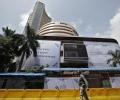
Gains were led by realty, auto, capital goods, banking, infrastructure, metals, power, oil & gas, PSU and consumer durables sectors, which rose up to 3.30 per cent.

Top gainers in the Sensex pack were Tata Motors, ONGC, Yes Bank, IndusInd Bank and Vedanta -- rising up to 2.71 per cent.
The benchmark BSE Sensex reclaimed the 28,000 mark, spurting by 409 points or 1.4% at 28,114 and Nifty settled above the 8,500 mark at 8,532, gains of 111 points.

'It is critical that the Covid curve does not have a fat tail and the chain is broken quickly.'

Ajit Mishra, vice president, Research, Religare Broking, answers your queries.

Investors turned cautious weighing weak GDP numbers and continued drop in automobile sales, bringing banking and auto sector stocks under pressure.
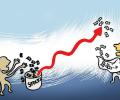
Small stocks made a dashing comeback in 2020 after delivering negative returns in the last two years as increased retail investor participation in pandemic times saw small-cap index surging up to 31 per cent and outperforming the bigger benchmark gauge. This year turned out to be eventful for the equity market, witnessing bearish and bullish sentiments at different points of time. While the initial part of COVID-ravaged 2020 saw the bears in full force amid concerns related to the pandemic and lockdowns hurting economic activities, bulls made a comeback towards the latter half of the year. As the market swayed with many lows as well as highs, small and mid-cap indices emerged as markets favourites in 2020.

Sustained foreign fund inflows and strengthening rupee are among the main reasons behind the market rally.

Investor wealth eroded by Rs 6.59 lakh crore on Monday as equities tanked after the UK reported a new strain of the COVID-19 virus. The 30-share BSE Sensex plunged 1,406.73 points or 3 per cent to close at 45,553.96. The benchmark hit an all-time high of 47,055.69 during the session. Following the sharp selling, the market capitalisation of BSE-listed firms plummeted by Rs 659,313.65 crore to Rs 1,78,79,323.05 crore.

Equity benchmarks Sensex and Nifty ended marginally lower on Tuesday as investors booked profits at higher levels amid a mixed trend in global markets.

The IIP data showed a significant slowdown in the manufacturing sector, which grew at 4.2 per cent in July 2019 as compared to 7 per cent a year ago.

Total net debt-equity ratio improves for third consecutive year, while investment in new projects hits a 10-year low, says Krishna Kant.
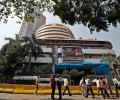
Broader market outperformed the headline indices with BSE Midcap and Smallcap finishing the day 1.22%, and 1.54% higher, respectively

The Indian economy is rapidly normalising towards pre-pandemic activity levels, even as uncertainty exists about coronavirus mutations and repeated infection waves, industrialist Kumar Mangalam Birla said on Wednesday. Vaccination is picking up pace, which would improve India's resilience against a potential third wave, the chairman of Aditya Birla Group said while virtually addressing shareholders at the AGM of group firm UltraTech Cement Ltd. Moreover, various steps taken by the RBI and the government have helped in containing the economic disruptions of the pandemic, Birla added.

L&T was the top gainer in the Sensex pack, spurting over 6 per cent, followed by Hero MotoCorp, HDFC Bank, IndusInd Bank, Maruti, HDFC and HCL Tech. On the other hand, ITC, SBI and Bharti Airtel ended in the red.
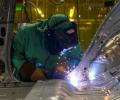
There was a slowdown in the manufacturing sector, which grew at 1.2 per cent in June 2019 as compared to 6.9 per cent a year ago.

Among the Sensex stocks, Tata Motors emerged as the top gainer, rising by 7 per cent. Yes Bank, ICICI Bank, Vedanta Ltd and Tata Steel were among the gainers.

'Debt mutual funds are a good option now because interest rates are coming down.' 'Retail investors must put a majority portion of your money in short-term debt funds (1 to 3 years) and only a small portion in actively managed dynamic funds.'

The laggards in the Sensex kitty were Vedanta, Tata Steel, M&M, HCL Tech, Bharti Airtel, Maruti Suzuki, L&T, Asian Paint and HDFC

The trade impact of the coronavirus epidemic for India is estimated to be about 348 million dollars (approximately Rs 25 billion) and the country figures among the top 15 economies most affected as slowdown of manufacturing in China disrupts world trade, according to a UN report. Estimates published by United Nations Conference on Trade and Development on Wednesday said that the slowdown of manufacturing in China due to the coronavirus (COVID-19) outbreak is disrupting world trade and could result in a 50 billion dollar decrease in exports across global value chains.

Titan was the top gainer in the Sensex pack, rising around 4 per cent, followed by HDFC, Nestle India, IndusInd Bank, UltraTech Cement and Bharti Airtel. On the other hand, Bajaj Auto, Tata Steel and NTPC were the laggards.

Bajaj Finance was the top laggard in the Sensex pack, skidding over 2 per cent, followed by Kotak Bank, Nestle India, HDFC, M&M and ICICI Bank. ONGC was the top gainer, rallying around 8 per cent. NTPC, Asian Paints, Tech Mahindra, PowerGrid and IndusInd Bank were among the other winners.

There, however, has been an improvement in operating margins.

ICICI Bank was the top gainer in the Sensex pack, rising over 3 per cent, followed by ITC, SBI, HCL Tech, Axis Bank, Bajaj Finserv and Tech Mahindra. NSE Nifty advanced 32 points to 15,856.05.

'The mismatch between valuations and fundamentals is startling,' warns Devangshu Datta
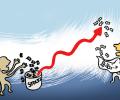
Ajit Mishra, vice president, Research, Religare Broking, answers queries on how to invest in stocks.

Top losers in the Sensex pack included ICICI Bank, Tata Steel, Vedanta, HDFC IndusInd Bank, Tata Motors, RIL and ONGC -- falling up to 4.45 per cent.

Sectorally, metal and banking stocks rallied the most, while FMCG and realty stocks came under selling pressure.

'Rising Covid cases and localised lockdowns are being closely monitored.'

Billionaire Mukesh Ambani's Reliance Industries Ltd on Friday announced the buyout of British battery maker Faradion Ltd for an enterprise value of 100 million, as the oil-to-retail conglomerate continued with the acquisition of end-to-end technology for its multi-billion-dollar clean energy portfolio. Reliance New Energy Solar Ltd (RNESL), a unit of the nation's most valuable company, signed definitive agreements to acquire 100 per cent shareholding in Faradion for an enterprise value of 100 million and will invest an additional 25 million as growth capital to accelerate the commercial roll-out, the company said in a statement. Based out of Sheffield and Oxford in the UK and with its patented sodium-ion battery technology, Faradion is one of the leading global battery technology companies.
 © 2026 Rediff.com - Advertise with us - Disclaimer - Privacy Policy - Sitemap - Feedback - About us - Terms of use - Grievances